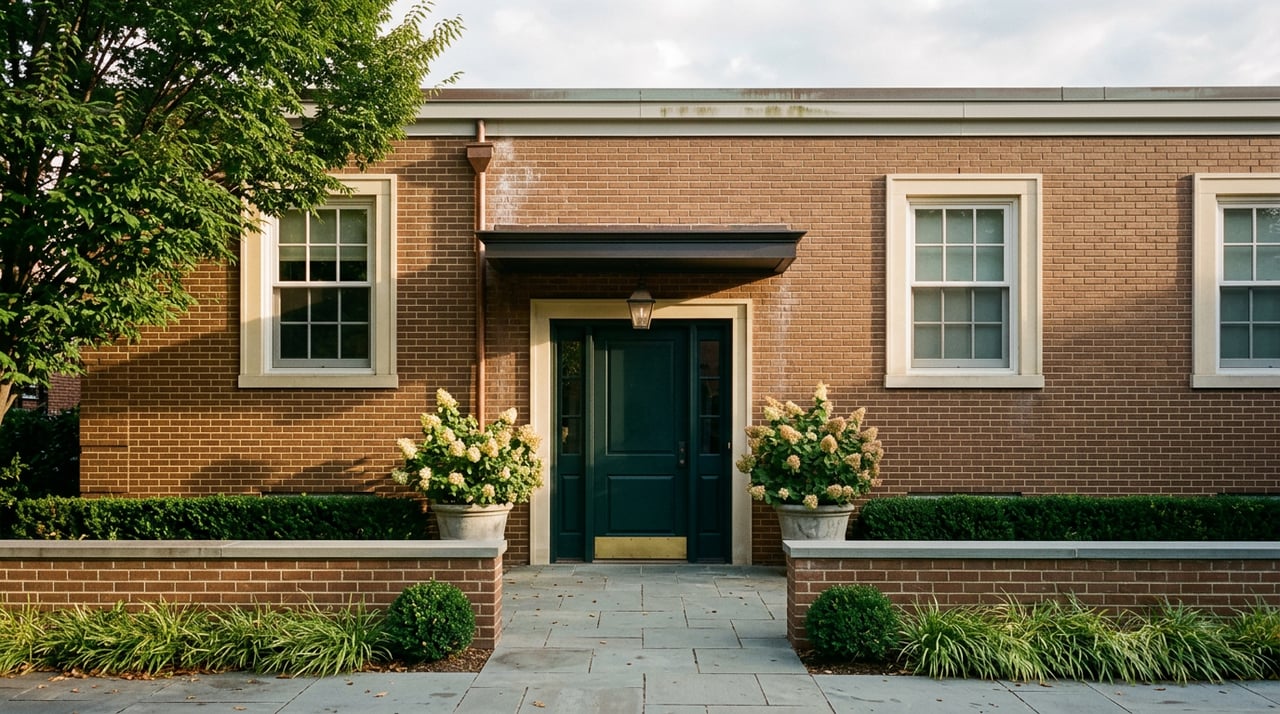
A four-story building on Laurel Avenue in Wellesley Hills has sat behind construction fencing since earlier this year, waiting, as The Swellesley Report has reported. It used to be a multi-tenant office building, the kind with a parking lot and a directory in the lobby. Before that, it was something else entirely: a house built in the early 1900s by Roger Babson, the same man who founded Babson College. Now it is neither office nor mansion. It is Wellesley's test case for what happens when a state housing law meets an actual piece of real estate.
If you are shopping for a home in Wellesley, or trying to sell one, this building matters more than its size suggests. It is the first project in town to use the zoning Wellesley adopted to comply with the MBTA Communities Act, the state law requiring towns near transit to allow multifamily housing by right. Understanding what this one building can and cannot tell you about the town's housing supply is the difference between planning a purchase around facts and planning it around a headline.
What Wellesley Actually Promised the State
Wellesley came into compliance with the MBTA Communities Law in 2024. As part of that compliance, the town's obligation was to zone for 1,392 units, with 90 percent of that capacity located within a half mile of a transit stop. That number gets repeated in local coverage as though it describes new homes about to hit the market. It does not. It describes a ceiling, not a forecast. Zoning capacity tells you what could theoretically be built if every eligible lot were redeveloped at maximum density. It says nothing about whether any given landowner wants to sell, whether a developer wants to build, or how long permitting takes once someone does.
In the year and a half since that compliance deadline, exactly one project is using the mechanism the town built for this purpose: the 28-unit condo conversion at 16 Laurel Ave. That is roughly 2 percent of the capacity Wellesley zoned for, with the project still in site plan review.
Two Buildings, Two Very Different Paths
The Laurel Avenue project is going through the Zoning Board of Appeals for site plan review. A public hearing opened on April 16, 2026, and the project has been working through that process since. Documents submitted to the town by developer Jeff Birnbaum, through Babson House LLC and Pioneer Construction, describe a four-story, 28-unit building steps from Le Petit Four Bakery, on the opposite side of Washington Street from the Wellesley Hills commuter rail stop. Six of the 28 units will be income-restricted, using a state affordability formula.
In a report by The Swellesley Report, Wellesley's Executive Director, Meghan Jop, described the project this way:
"They have been evaluating this site for some time to convert to residential units. It is a good location and I think the developers have a thoughtful design. There will be a number of considerations to review during site plan."
A short walk away, a second project tells a stranger story. At 592 Washington St, next to The Belclare condo complex, a developer is building 19 units in a three-story building that sits inside an MBTA Communities zone. That developer could have used the same by-right zoning that governs Laurel Avenue. Instead, the project went through the Project of Significant Impact process, a slower, discretionary special permit track. The Wellesley Square Commercial District special permit for that project was granted by the Planning Board on January 26, 2026. The reason for the slower route: it allowed more density than the as-of-right MBTA zoning would have permitted on that lot.
Project | Address | Units | Permitting Path | Latest Confirmed Milestone |
|---|---|---|---|---|
Former office building | 16 Laurel Ave | 28 | MBTA Communities by-right zoning | ZBA site plan hearing opened April 16, 2026 |
New construction | 592 Washington St | 19 | Project of Significant Impact special permit | Special permit granted January 26, 2026 |
These projects followed different paths. For the 592 Washington St project, the developer chose the slower special-permit route because it allowed more density on that lot. If that pattern holds elsewhere in town, the MBTA Communities zoning may serve as a baseline, while some projects pursue other paths for greater density.
How Long the Laurel Avenue Project May Take
Even the project that is using the new zoning is not close to finished. As of this spring, the developer at 16 Laurel Ave hoped to start digging this summer, with an estimated 18 months to complete construction once ground breaks. If that holds, the building would likely open sometime in late 2027 or early 2028, not this year.
That timeline matters for anyone assuming rezoning translates into near-term relief. Combine the two projects and you get 47 units moving toward construction against a theoretical capacity of 1,392. Most of that capacity remains exactly what it was when the town hit its compliance deadline: lines on a zoning map, not homes.
Meanwhile, the Existing Market Is Splitting
While the new zoning slowly works its way through permitting, the homes already for sale in Wellesley are behaving in two different, almost contradictory ways.
On the single-family side, the market has cooled from its recent peak without collapsing. Buyers are more selective and more willing to negotiate than they were a year or two ago, and homes that once sold within days are now taking longer to find a buyer. Sellers are still closing deals, but the days of automatic multiple offers over asking have given ground to a market that rewards accurate pricing over aspirational pricing.
The condo market is telling a different story. A year-end review of 2025 sales by the Pinnacle Report found that condo inventory in Wellesley had been cut in half, down to just seven active listings from the year before. At the same time, activity at the top of the single-family market picked up, with the number of luxury sales climbing from 17 in 2024 to 27 in 2025 and the median sale price landing at $2,210,652 for the year.
Put those two facts next to the zoning math above and the picture sharpens. The segment of the market with the least breathing room right now, condos, is also the segment the MBTA Communities zoning was specifically designed to expand. And the actual new supply in that segment, as of this writing, is one 28-unit building still going through hearings.
What This Means Depending on Where You Sit
If you are a buyer or downsizer hoping for more Wellesley condos to choose from, do not plan your search around zoning capacity that has not converted to inventory. The realistic near-term supply is what already exists or is already under construction, not the 1,392-unit ceiling. If a smaller home in Wellesley is the goal, the honest timeline for new zoning-driven inventory runs into late 2027 or 2028 at the earliest, and that is only if 16 Laurel Ave proceeds on schedule.
If you own a single-family home near a transit stop, a nearby multifamily project is not the same thing as a wave of new competition arriving next spring. Both Laurel Avenue and 592 Washington St have been years in the making and will take years more. What is affecting your listing right now is the broader shift toward longer days on market and more careful buyers, not a sudden change in the neighborhood's housing stock.
If you are weighing Wellesley against a neighboring town partly because you assume new zoning will bring prices down, that assumption does not hold up against the current pipeline. Two projects, one of them using zoning that did not exist before 2024, is not evidence of a supply wave. It is evidence that even favorable zoning takes years to become actual walls and roofs.
Quick Answers
Will the MBTA Communities zoning eventually add meaningful housing supply in Wellesley? Possibly, over a long horizon. The zoning capacity exists for 1,392 units. Whether landowners and developers use it depends on land economics that change site by site, which is exactly why only one project has moved in the year and a half since the town's compliance deadline.
Why did the 592 Washington St developer avoid the new zoning if it was meant to make building easier? Because the alternative path allowed more units per lot. The Project of Significant Impact process is slower and more discretionary, but it produced a better outcome for that specific project, which is a useful reminder that easier is not always more profitable.
Does the current slowdown in single-family days on market mean prices are falling? Not based on what the data shows so far. Luxury sales volume grew and the median sale price held at $2.2 million for 2025. What changed is how long it takes to get there and how much negotiating room buyers have along the way.
Wellesley's housing story right now is not about a flood of new units. It is about a wide gap between what the town is zoned for and what is actually under a roof, and a resale market that is tightening in exactly the segment where new supply would help most. Numbers on a zoning map are not the same as a home you can walk through, and the gap between the two is where good decisions get made or missed.
If you are trying to figure out what any of this means for your specific address, whether you are weighing a sale, sizing up a condo purchase, or comparing Wellesley to a neighboring town, Alison Borrelli can walk you through what the data actually supports. Get Your Free Home Value Report and start the conversation with real numbers, not a zoning map.
This article is general information, not legal, tax or financial advice. Consult a qualified professional about your situation.