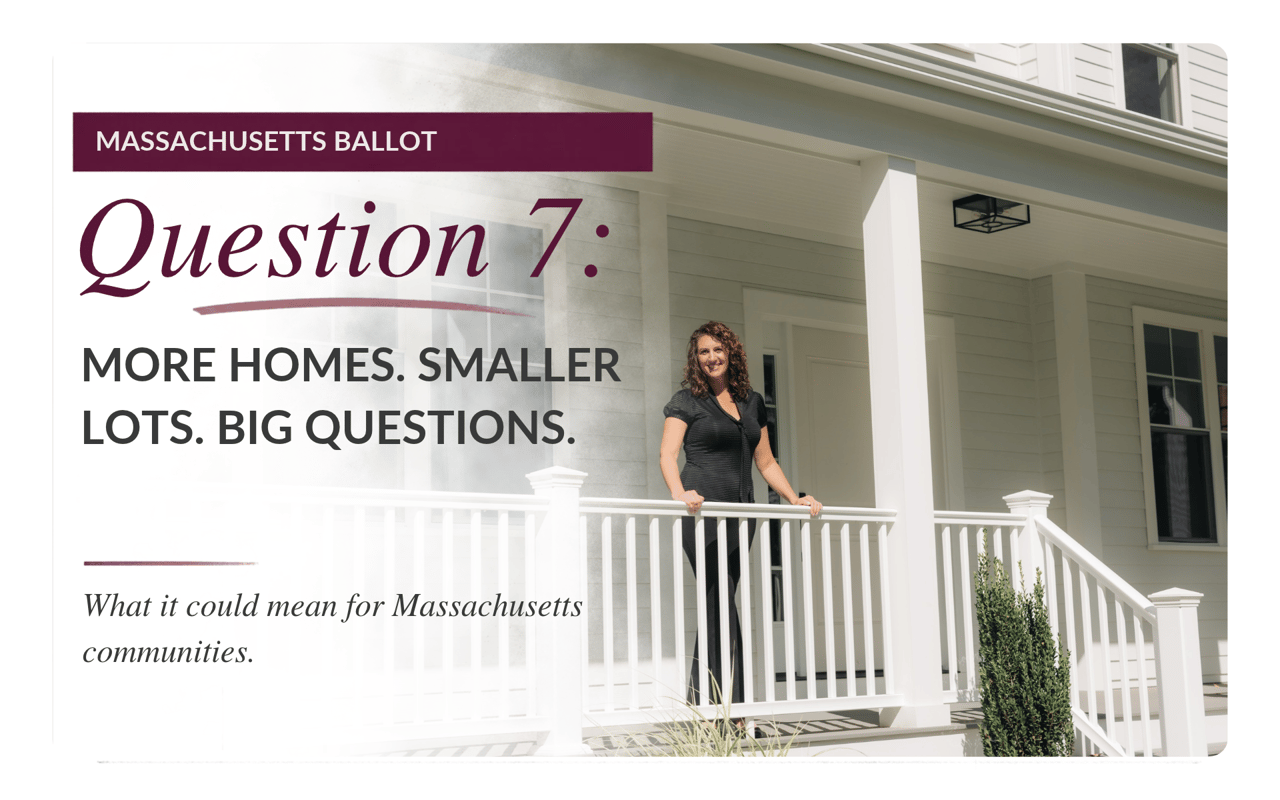
What the proposed starter home law would change, why supporters believe it could help, and what it could mean for Needham and surrounding communities.
Massachusetts has a housing problem. Home prices have climbed, inventory remains limited, and many first-time buyers are struggling to find a home they can afford. At the same time, longtime homeowners who want to downsize often discover that smaller, more manageable homes are difficult to find in the communities where they've spent their lives.
One proposal aimed at addressing this challenge is Ballot Question 7, commonly referred to as "Legalize Starter Homes."
As a REALTOR® serving the Greater Boston area and a member of the Massachusetts Association of REALTORS® Government Affairs Committee, the Greater Boston Real Estate Board (GBREB), and its Government Affairs Committee, I've been following this proposal closely.
These real estate organizations have voted to support Question 7, recognizing the need to create additional housing opportunities.
I support the proposal as well, although I believe there are legitimate concerns about applying the same zoning standards to 351 very different Massachusetts communities.
Here's what voters should know before heading to the polls on November 3.
What Would Question 7 Actually Do?
Question 7 would change Massachusetts zoning law to make it easier to build single-family homes on smaller lots.
Under the proposed law, qualifying lots would need to meet three basic requirements:
- At least 5,000 square feet of land.
- At least 50 feet of street frontage.
- Access to public water and public sewer.
The property would also need to be in an area zoned for residential use.
Currently, many Massachusetts communities require significantly larger lots and more frontage for new single-family homes.
Question 7 would override certain local zoning restrictions that prevent qualifying lots from being used for single-family homes. However, municipalities would retain the ability to establish reasonable regulations concerning setbacks, building height, building size, and other development standards.
In simple terms, the proposal would make more land potentially eligible for residential construction.
It would not mean that every property could automatically be subdivided or that every proposed home could be built without meeting other applicable requirements.
Why Do Supporters Believe This Will Help?
Supporters argue that restrictive zoning contributes to the high cost of housing in Massachusetts.
When land is expensive and zoning requires large lots, builders often construct larger, more expensive homes to make projects financially viable.
Allowing homes on smaller lots could change that equation.
A property that previously accommodated one home might, depending on its dimensions and other requirements, be suitable for two smaller homes.
Supporters believe this could create more opportunities for first-time buyers, young families, and older homeowners who want to downsize.
It could also provide an alternative to the increasingly common pattern of replacing modest older homes with significantly larger, more expensive new construction.
The broader goal is to increase housing supply and introduce more variety into a market that desperately needs both.
Why Are Some Communities Concerned?
While the goal of creating more housing is widely shared, there is disagreement about whether Question 7 is the best way to accomplish it.
The Massachusetts Municipal Association (MMA), which represents municipal interests across the Commonwealth, has publicly opposed the proposal.
Its concerns center on local control, infrastructure, community planning, and whether the legislation would actually produce more affordable homes.
I believe these concerns deserve serious consideration.
1. One Size Doesn't Necessarily Fit All
Massachusetts has 351 cities and towns, each with different development patterns, infrastructure, housing needs, and environmental considerations.
A zoning standard that makes sense in one community may create challenges in another.
Some municipalities have already adopted zoning changes to encourage additional housing. Others are working through comprehensive planning processes that balance housing needs with infrastructure, environmental protection, and neighborhood development.
Question 7 would establish a statewide standard rather than allowing each municipality to determine its own minimum lot sizes.
The question is whether a statewide approach is necessary to overcome restrictive zoning or whether it removes too much local decision-making.
2. Smaller Lots Don't Guarantee Affordable Homes
This is an especially important distinction.
Question 7 is promoted as a way to legalize starter homes, but the proposed law does not establish a maximum home size, maximum sale price, or affordability requirement.
A builder could potentially construct a relatively expensive home on a 5,000-square-foot lot.
In communities where land values are already high, reducing the minimum lot size may create additional development opportunities without necessarily producing homes affordable to first-time buyers.
That doesn't mean smaller lots won't help. Increasing the number of homes can create more options and may help moderate housing costs over time.
But allowing smaller lots and guaranteeing affordable homes are two very different things.
3. Infrastructure and Environmental Considerations Matter
Question 7 requires access to public water and sewer, but access alone doesn't necessarily establish that existing infrastructure can accommodate additional development.
Municipalities also need to consider stormwater management, drainage, road conditions, schools, public safety, and other services.
There are environmental questions as well.
For example, communities working to preserve mature trees, protect open space, and manage stormwater may face additional challenges when larger parcels are divided into smaller lots.
Reasonable local regulations would still be permitted, but questions remain about how those regulations would interact with the new statewide requirements.
4. Local Planning Could Become More Complicated
Zoning decisions typically involve planning boards, public hearings, town meetings, and opportunities for residents to participate.
Question 7 would limit certain discretionary zoning approvals for qualifying single-family homes.
Supporters view that as a benefit because it removes barriers that can delay or prevent housing construction.
Opponents worry that it could reduce the ability of municipalities to guide development through established local planning processes.
Both perspectives raise important questions about how Massachusetts should balance statewide housing needs with local decision-making.
What Could Question 7 Mean for Needham?
This is where the conversation becomes particularly interesting.
In an October 28 article in the Needham Observer, reporter Peter O'Neil explored how Question 7 could affect our community, including perspectives from local housing advocates and my own comments as a REALTOR®.
One of the most interesting findings was that, according to research discussed in the article, only 387 properties, approximately 4.3% of Needham's nearly 9,000 properties in the SRA and SRB zoning districts, potentially meet the requirements for subdivision into two lots under Question 7.
That's an important distinction. While the proposal could create new development opportunities, it doesn't mean every oversized lot in Needham could suddenly be divided.
But the potential benefit isn't necessarily about creating a large number of homes. It's about creating different housing options.
As I shared with the Needham Observer, we have very limited inventory of smaller, detached, newly constructed single-family homes priced below $2 million.
At the time of the interview, 17 newly constructed single-family homes were listed in Needham, with an average asking price of approximately $2.95 million and the lowest asking price at $2.3 million.
Could allowing homes on smaller lots create opportunities for new construction at lower price points? Potentially.
A newly constructed home priced at $1.6 million or $1.8 million certainly wouldn't be considered affordable by most standards. But in Needham's new construction market, it would represent a different price point and potentially serve buyers who currently have very few options.
Planning Board member Oscar Mertz, also quoted in the article, described Question 7 as another incremental tool for expanding housing choices, similar to accessory dwelling units.
I think that's a useful way to consider the proposal.
Question 7 isn't going to solve Needham's housing shortage on its own. But it could help create a type of housing our community needs.
You can read the full article here: Starter Home Referendum Aims to Boost Housing Production, Needham Observer, October 28, 2026.
What About Other Greater Boston Communities?
The potential impact of Question 7 would vary significantly from town to town.
In communities such as Newton, Wellesley, Dover, Weston, and other Greater Boston suburbs, land values are already substantial.
Even where smaller lots become possible, the economics of land acquisition, construction costs, and local building requirements would influence what ultimately gets built.
For example, a property with sufficient land area and frontage might be suitable for subdivision into two smaller lots.
That could create an opportunity for two detached homes at a lower price point than a single large luxury home.
But whether those homes would actually be built, what they would cost, and how they would fit into the surrounding neighborhood would depend on the individual property and applicable regulations.
This is why I believe the details matter so much.
My Perspective: We Need More Housing, but the Details Matter
Working with buyers and sellers every day, I see the challenges created by our limited housing supply.
I work with first-time buyers who struggle to compete, families searching for homes that fit their changing needs, and longtime residents who would love to downsize without leaving their community.
We need more housing options, and we need to be open to solutions that allow communities to evolve.
I support Question 7 because I believe Massachusetts needs more housing choices, and this proposal could help create some of them.
But my support comes with reservations, particularly about applying the same zoning standards to communities with very different infrastructure, development patterns, and local needs.
I also don't believe we should assume that smaller lots will automatically result in affordable homes.
Question 7 presents an opportunity, especially in communities where existing zoning makes it difficult to create smaller single-family lots. But it is one potential tool, not a complete solution to our housing challenges.
For me, the goal is not simply to build more homes. It's to create housing opportunities that meet the needs of our communities, today and in the future.
What Does a YES or NO Vote Mean?
A YES vote would establish new statewide protections allowing single-family homes on qualifying lots of at least 5,000 square feet with 50 feet of frontage and access to public water and sewer, subject to reasonable local regulations.
A NO vote would leave the existing zoning framework unchanged. Municipalities could continue to make changes to their local zoning requirements through their established processes.
Whatever your position, I encourage you to understand both the opportunities and the potential consequences before voting.
Housing is one of the most important challenges facing Massachusetts, and decisions about how and where we build will shape our communities for years to come.
Election Day is Tuesday, November 3, 2026.