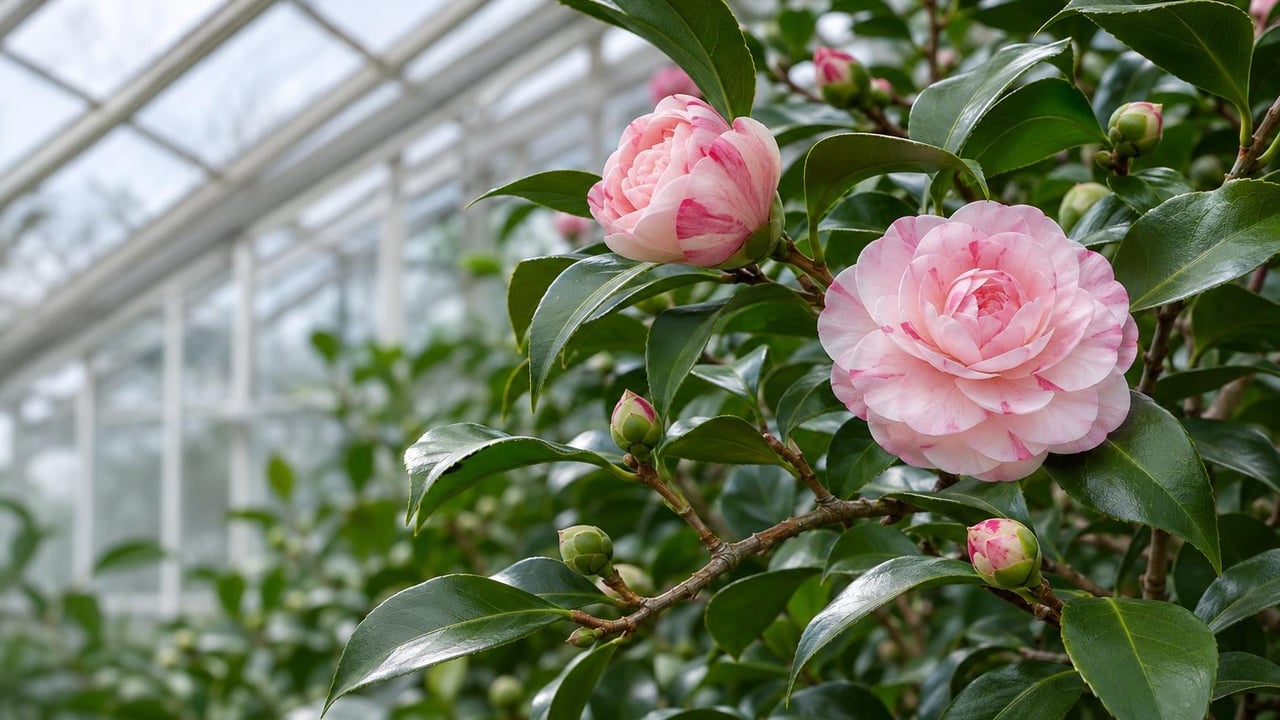
Inside the Camellia Pavilion at Wellesley College's Global Flora conservatory is a ten-foot Camellia japonica that Henry Durant grew and gave to the college in the 1870s. The college's botanic gardens staff count on it to come into bud in November. The flowers usually open in late January and last through most of February, with a second bloom in April and May.
The conservatory's public hours make that timing matter. Global Flora is free to visit on Sundays, and the fall 2026 season ends December 6. Last winter the public closure ran from December 8 through January 31, and Sunday hours came back on February 1, 2026. The winter before, public hours came back on January 26, 2025. Both of those reopening dates fall within the late-January-to-February stretch that the college gives for the bloom.
If you live in Wellesley, that gives you two short windows to plan around. The first is the next two weeks, the usual bud season, while the Davis Museum still has events on its calendar. The second is the first Sundays of February, when the tree has usually been in flower. Here they are in order.
Thanksgiving Weekend
Today the Davis Museum is closed for Thanksgiving, and it stays closed Friday. It reopens Saturday, November 28. The Saturday drop-in tour is skipped this week, and Global Flora is closed Sunday, November 29.
The 22-acre outdoor gardens are open all weekend. In fact they never close: the college keeps them open every day, all day, all year. Leashed dogs are welcome, and you can walk in at Paramecium Pond off College Road or along Central Street. If you have guests in town and need a walk between meals, start here. Maps are posted outside the Visitor Center around the clock and online.
Saturday, December 5, and Sunday, December 6
This weekend has the last of each campus routine for the fall.
On Saturday, the Davis Museum runs its final free drop-in public tour of the season from 2 to 3 p.m. The Saturday tours have run since September 26. The Davis is open Tuesday through Sunday, 11 a.m. to 5 p.m., and admission is free.
On Sunday, Global Flora and the WCBG Visitor Center are open from 9:30 a.m. to 2:30 p.m. for the last time this fall. The conservatory opened in 2019 and has three sections. The Camellia Pavilion holds the Durant Camellia. The Dry Biome has plants adapted to deserts and dry climates, and the Wet Biome has plants from humid subtropical regions. Between them, the collection covers every continent except Antarctica. There's also a mangrove and a paludarium, a mezzanine with a piano and seating, and the Link, an art exhibit space that connects the conservatory to the Visitor Center. On a December morning, the walk from the Dry Biome to the Wet Biome is about as far from a New England winter as you can get within town lines.
Visiting is free, and small parties and families don't need a reservation. The college asks groups of eight or more to give notice ahead of time. The paths work for wheelchairs and strollers. Service animals are welcome inside, but pets are not. The Visitor Center has accessible restrooms, water fountains and a changing station.
Parking is the one practical detail that has changed. There's construction near the Visitor Center, and the spaces closest to it are limited to two hours. The college recommends the Davis garage, which is free all day. If the gate is down, press the buzzer, say you're visiting the Botanic Gardens, and plan on a ten-minute walk. With free all-day parking, you can tour the Davis on Saturday and come back for the greenhouse on Sunday without moving your car to a meter, or fit both into one long Sunday, since the Davis opens at 11.
December 8 to 20 at the Davis
After the greenhouse closes, the Davis Museum keeps going for two more weeks. A Print and Frame Sale runs in the museum lobby from December 8 through December 20, 11 a.m. to 5 p.m. daily during museum hours. If you're looking for a holiday gift with a Wellesley connection, this is the one on campus.
The galleries are showing two exhibitions. "Excavating Antioch: The Archaeology of an Ancient City" covers the ancient city and its 1930s excavation through artifacts and archival material. "Shi: Stories in Stone" looks at the Chinese tradition of collecting and studying rocks, minerals and fossils, including scholar's rocks. The museum lists both through May 30, 2027, so you can come back in spring. Their December event listings run through December 20, the same day the print sale ends.
Last year, the Davis closed for Wellesley College's winter break from December 16, 2025 through February 6, 2026, and held its spring opening celebration on February 5. If the exhibitions are on your list, the museum's current calendar runs through December 20.
The Weeks Only the Gardens Are Open
After December 6, the outdoor gardens are the part of the Botanic Gardens you can visit. They stay open every day through the winter, though path conditions depend on the weather. The Paramecium Pond entrance off College Road leads to the same Visitor Center you'll come back to in February, so a January walk there is a good way to learn the route before the conservatory opens again.
The camellia is growing through these weeks too. Gail Kahn, then assistant director of the botanic gardens, described the late-January bloom in a 2016 Wellesley College article: "Their arrival is a welcome respite from the cold of late January."
February, When the Camellia Opens
The Durant Camellia is one of the few things on campus with the Durant name. That same 2016 college article explains why. Henry Durant raised four camellias and gave them to the college. Two stood in College Hall's Great Hall and were lost in the fire of 1914. The other two went into the Seasonal Display House when the Ferguson Greenhouses were built in 1922. As they grew, they crowded each other, and one was cut down. The tree that remained gradually came to be called the Durant camellia. Kahn noted that the founders didn't want buildings named after them. The tree now has its own pavilion in Global Flora.
The flowers are why it's worth planning for. The article describes them as a formal double form, with many regular rows of petals and no visible stamens. They're striped and spotted in shades from dark pink to nearly white, and a harmless virus causes the pattern. Kahn said the garden had never seen another camellia like it and called it the most important plant in the greenhouse collection. She also mentioned reading that camellias were Pauline Durant's favorite flower. A 2022 Wellesley student StoryMap recorded the tree in bloom in February and again in April.
In recent years, February is when the conservatory has reopened. Spring 2026 hours ran on Sundays from 9:30 a.m. to 2:30 p.m., February 1 through April 26. Spring 2025 hours began January 26 and included Tuesday and Thursday afternoons, noon to 4 p.m., as well as Sundays. In both years, the first Sundays of spring hours fell inside the camellia's usual late-January-to-February bloom. The April and May bloom is a second chance for anyone who misses February.
The Davis Museum's spring has one event on the calendar so far. "In Conversation: Yu-Wen Wu" is on Tuesday, February 2, 2027, from 5 to 6:30 p.m. at Collins Cinema.
Dates like these are part of living in Wellesley, the same way commuter schedules and school calendars are. If you'd like the February greenhouse hours and other local dates when they're posted, sign up for my newsletter. You'll find more about the town on the Wellesley page at Alison Borrelli, and I'm always glad to hear which Sunday you made it out to see the camellia.